


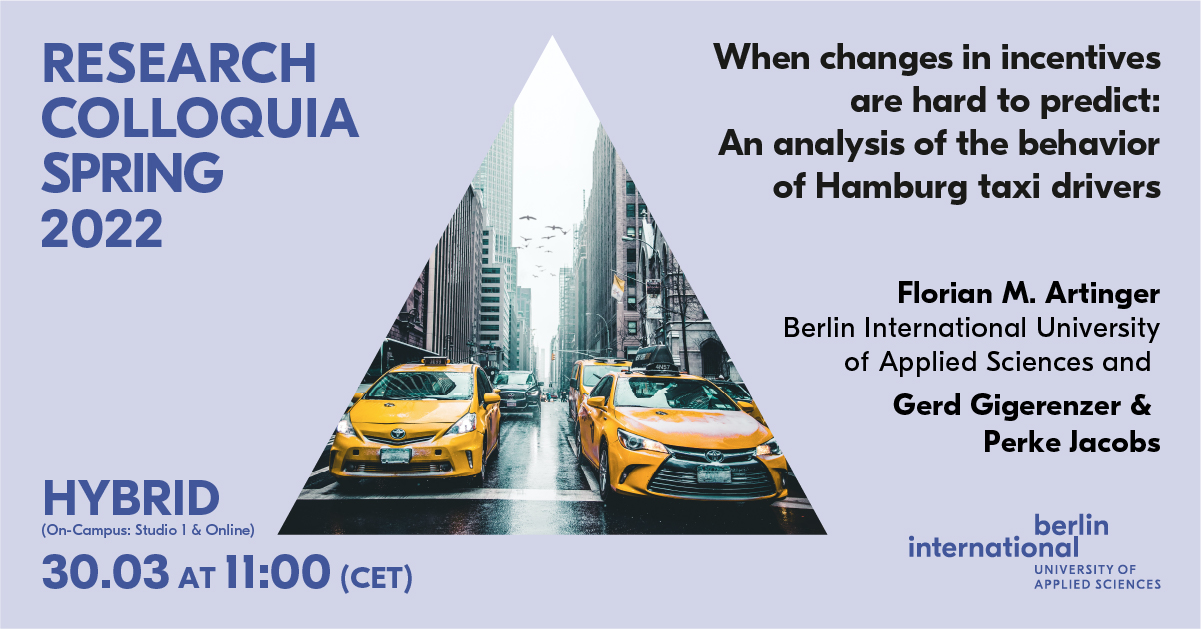
On Wednesday, March 30, between 11:00 and 12:30, the first Research Colloquium of the Summer Semester 2022 will take place. Our guests, Prof. Dr. Florian Artinger from the Berlin International University of Applied Sciences and his colleagues Prof. Dr. Gerd Gigerenzer and Perke Jacobs will present their research project. The title of the presentation is "When changes in incentives are hard to predict: An analysis of the behavior of Hamburg taxi drivers". Following the presentation, there will be an opportunity to ask questions and discuss.
The research colloquium will take place in a hybrid format, at the campus at Salzufer 6, 10587 Berlin in Studio 1, and via Zoom.
Below are the details for joining via ZOOM.
Join Zoom Meeting:
https://us02web.zoom.us/j/85725964541?pwd=MTdiMlFlVmtxd3k4WWJ1SmVrSTd4UT09
Meeting ID: 857 2596 4541
Passcode: 865371
Students across all disciplines are invited to participate in an interdisciplinary exchange. Be inspired and get to know new perspectives!
When changes in incentives are hard to predict: An analysis of the behavior of Hamburg taxi drivers
by Florian M. Artinger, Gerd Gigerenzer, Perke Jacobs
At the heart of economics is the study of how incentives shape behavior. In its simplest form this implies that if people can get more money, they are expected to work more. However, an influential study in 1997 by Colin Camerer and colleagues suggests that people violate this basic assumption. Studying as an example the behavior of New York taxi drivers who can freely allocate their time, the authors find that drivers use an income target for a given day. Such a target is for instance to earn 100 USD. If drivers reach the target, they stop their shift. This implies that if on a given day there is more demand for taxi drivers and hence higher hourly wages, they more quickly reach their income target and stop early. Economic theory suggests otherwise – if there is an opportunity to earn higher hourly wages than usually, this should yield greater effort and longer working hours. The study by Camerer et al. has become the poster child of Behavioral Economics whereby people apparently act irrationally and violate economic theory. In this study we analyze the behavior of Hamburg taxi drivers (the data from New York have not been publicly available) and show that taxi drivers act by no means irrational. Rather it is hardly possible to predict changes in hourly wages. We present an alternative way of understanding behavior that portraits taxi drivers as anything else but irrational.
Florian Artinger is a Professor of Business Administration at the Berlin International University of Applied Sciences, co-founder and managing partner of Simply Rational – The Decision Institute, and an associate researcher at the Max Planck Institute for Human Development. He received his PhD from the Max Planck Institute and has been a researcher at the University of Warwick, the University of Chicago, and the University of Oxford. Florian Artinger's work includes teaching, research, and consulting in the areas of decision making, management, and machine learning. As co-founder and managing partner of Simply Rational, Florian Artinger helps organizations measurably improve their decision-making processes. To do so, Simply Rational leverages Nobel Prize-winning insights from behavioral science and the latest machine learning methods. His clients include Morningstar Investment, the German Football Association (DFB) and the City of Berlin. His work has been published in leading academic journals and has won international awards. He is a keynote speaker at practitioner conferences and has taught managers and financial analysts the art and science of good decision making.
Prof. Dr. Gerd Gigerenzer is the most cited German psychologist and one of the most influential psychologists in the world. He is Director of the Harding Center for Risk Literacy at the University of Potsdam, Faculty of Health Sciences Brandenburg and partner of Simply Rational – The Decision Institute. He is former Director of the Center for Adaptive Behavior and Cognition (ABC) at the Max Planck Institute for Human Development.
Perke Jacobs is a doctoral candidate at the Max Planck Institute for Human Development. Moreover, he is an economist at the German Federal Chancellery. Previously, he studied statistics, economics, and psychology at Maastricht University, UCSD, and Tilburg University, and worked as a data scientist. His research interests include ecological rationality, machine learning, public policy and labor economics.
