


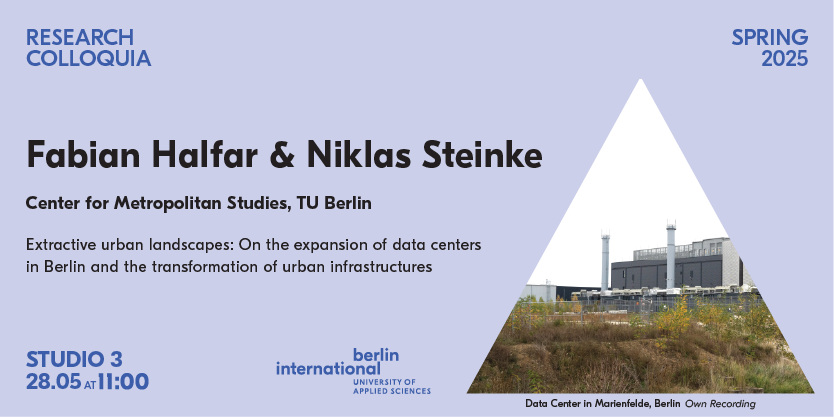
Extractive urban landscapes: On the expansion of data centers in berlin and the transformation of urban infrastructures
At the latest Research Colloquium held at Berlin International, the focus shifted from architecture and design to infrastructure and digital power. Fabian Halfar and Niklas Steinke, both engaged in critical urban research, took the floor to present their compelling findings on the expanding footprint of data centers—and their deep, often overlooked impact on Berlin’s electricity infrastructure.
Their presentation shed light on a growing tension: the rapid rise of data centers is exerting enormous pressure on the city's already burdened urban power grid. These centers—integral to digital economies—consume vast amounts of electricity, reshaping how power is distributed across the city.
One of the most concerning developments, they argued, is the speculative securing of high-voltage grid connections. Often obtained long before actual use and in volumes exceeding current needs, these speculative claims effectively capture and block off portions of the grid. As a result, powerful digital actors—cloud providers, real estate developers, and global tech firms—are reorienting critical infrastructure in their favor.
This trend, which the presenters referred to using the term digitally induced infrastructure extractivism, describes a process where digital businesses appropriate and scale urban infrastructure to suit data-driven models. But this shift comes with a cost. Smaller, local businesses—those without the capital or influence to stake their claim—are increasingly edged out.
What emerges is a form of what has been described in Sweden as energy gentrification: a gradual displacement of smaller players from the energy market, driven by unequal access to power itself.
As Berlin continues to grow as a strategic site for data center investment, Halfar and Steinke’s call was clear: we must take a closer look at how digital infrastructures silently but significantly reshape urban life—not just digitally, but spatially, socially, and politically.
Their research opens up crucial conversations at the intersection of technology, urban policy, and justice. In a time when infrastructure is often invisible until it fails or is contested, this work invites students, researchers, and city-makers alike to ask: who gets access, who gets excluded, and what kind of city do we want to build?
Thank you to Fabian Halfar and Niklas Steinke for their thought-provoking contribution. For those interested in continuing the conversation or reaching out directly, feel free to contact them at:
n.steinke@campus.tu-berlin.de
fa.halfar@googlemail.com

