


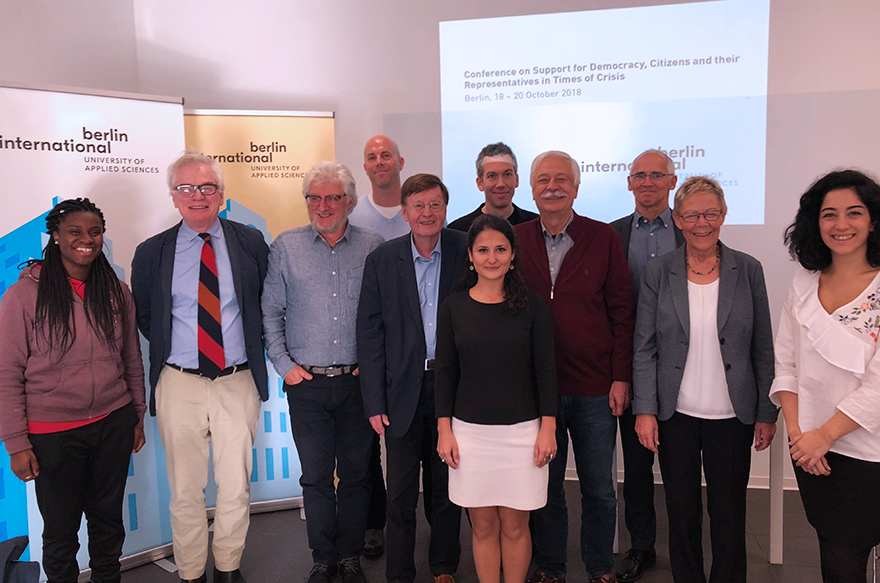
Berlin International has hosted an international conference to discuss ‘Support for Democracy: Citizens and their Representatives in Times of Crisis’. This was the final meeting of a project funded by the Swedish Riksbanken Jubileumsfond. Berlin International’s Vice-President, Prof. Dr. Peter Mantel, welcomed the participants.
Has there been a decline in support for democracy in the aftermath of the 2007/08 global fiscal crisis and the subsequent economic recession? This was the general question the speakers tried to answer. The empirical analyses compared five ‘young’ (Chile, Poland, South Africa, South Korea, Turkey) and two ‘old’ democracies (Sweden, Germany). The comparisons made use of survey data taken in 2007 and 2013 of citizens and members of the national parliaments allowing a ‘before and after the crisis’ design.
Prof. Dr. Heinrich Best, Friedrich-Schiller University Jena, gave the keynote address which dealt with general issues of elite theory and political representation. Six papers were read on specific issues by participants from Germany, Poland, Sweden and Turkey. Prof. Dr. Bernhard Weßels, Berlin Social Science Center, served as Rapporteur General and delivered a critical appraisal of results. The papers of this international conference will be published in a special issue of the journal Historical Social Research.
Following topics were addressed by the representatives:
Prof. Dr. Heinrich Best, Friedrich-Schiller-Universität Jena, Germany
Ursula Hoffmann-Lange, Universität Bamberg, Germany
Radoslaw Markowski and Agnieszka Kwiatkowska, University of Social Sciences and Humanities, Warsaw, Poland
Hans-Dieter Klingemann, Berlin International University of Applied Sciences, Germany
Patrik Öhberg, University of Gothenburg, Sweden
Han, Sang-Jin, Seoul National University and Shim, Young-Hee, Hanyang University, South Korea (Summary presented by Ursula Hoffmann-Lange)
Yilmaz Esmer and Bahar Ayca Okcuoglu, Bahcesehir University, Istanbul, Turkey


